
Read the 1956 legacy
Connect the town centre with the Games that changed Cortina's international image.
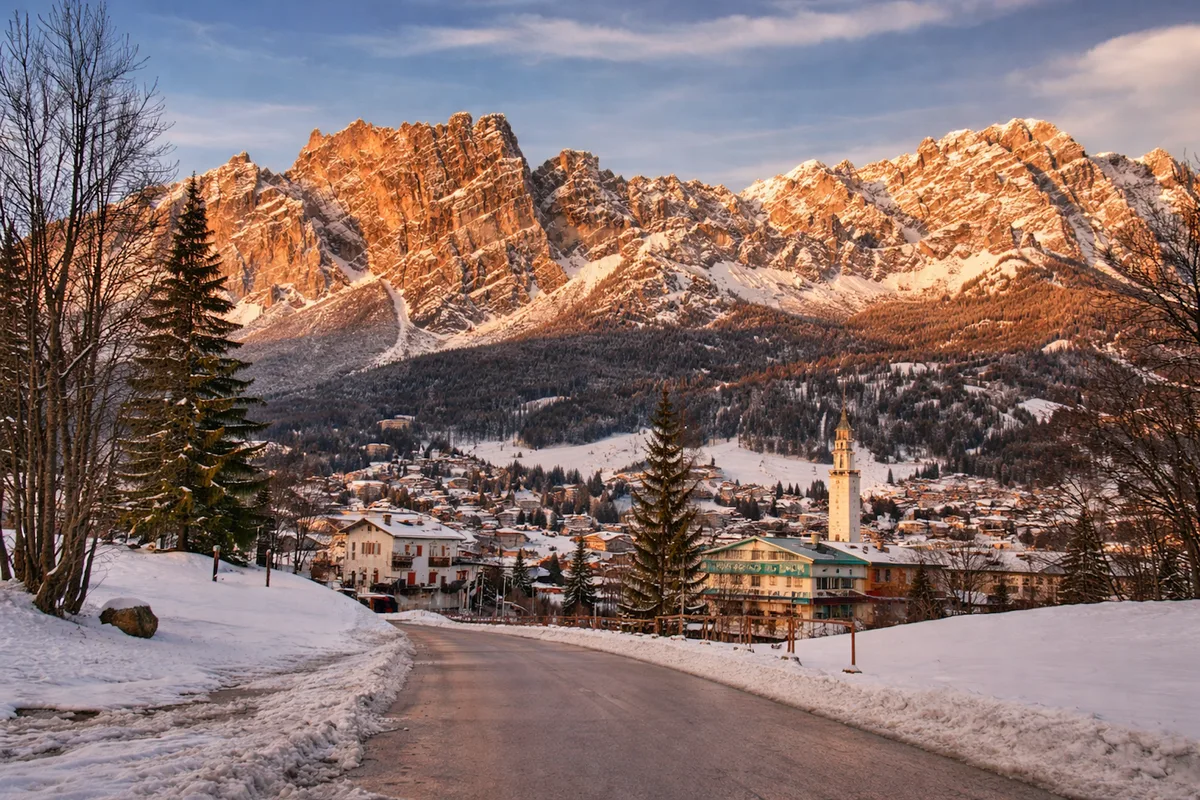
Understand Cortina as an Olympic town, not only an Alpine resort.
Explore Cortina d'Ampezzo through the stories that shaped it as a global Winter Olympics destination — from the 1956 Games and the first Olympic television broadcast to legendary athletes, Alpine glamour and the legacy renewed by Milano Cortina 2026.
See what you will understandConnect the town centre with the Games that changed Cortina's international image.
Place athletes, television, glamour and fair play inside the streets and mountains that shaped them.
Use a compact route to understand Cortina's civic memory, even outside a ski day.
Editorial perspective
Cortina's Olympic identity is not a single event label. It is a long accumulation of sport, image, landscape and local pride, beginning well before the renewed attention around Milano Cortina 2026.
GeoBeat keeps the focus on legacy: how the 1956 Games, televised modernity, athletes and the Dolomites still shape the way the town presents itself.
A concise preview of what you will hear along the walk.
The walk opens in Cortina's civic centre, tracing how the 1956 Games transformed an Alpine town into the first Winter Olympics broadcast to an international television audience — across Europe via Eurovision.
Stories of athletes whose choices — on the slope and off it — gave the 1956 Games a human dimension that lasted well beyond the medal ceremony.
In the 1950s, Cortina attracted cinema, fashion and international press. This stop reads the town's reputation as a stage for both sport and a particular kind of Alpine elegance.
Names and moments that became part of Cortina's sporting canon — and of Italian winter sport history across three generations.
And more along the route.
The walk connects Olympic memory with the town in front of you.
A clear route, written for listening while you move.
Each stop is chosen for cultural meaning, not as a generic checklist.
The route connects places into a simple narrative you can follow on foot.
The text is shaped for listening in place, with enough context to stay clear.
The walk gives you orientation without replacing the full VoiceMap experience.
Search can give you Olympic dates and medal tables. GeoBeat connects those facts to the town's streets, views and memory, so the legacy becomes walkable.
You want to understand Cortina's place in Winter Games history beyond basic facts.
You are interested in how landscape, sport and public image shape a mountain town.
You prefer a flexible route through the centre without a guided group.
You want the 2026 story framed through memory, continuity and urban identity.
Follow the town centre with context for 1956, the Dolomites and the legacy that continues around the Winter Games.