
Meet Dante as a Florentine
See the poet within the streets, guilds and institutions that shaped his public life.
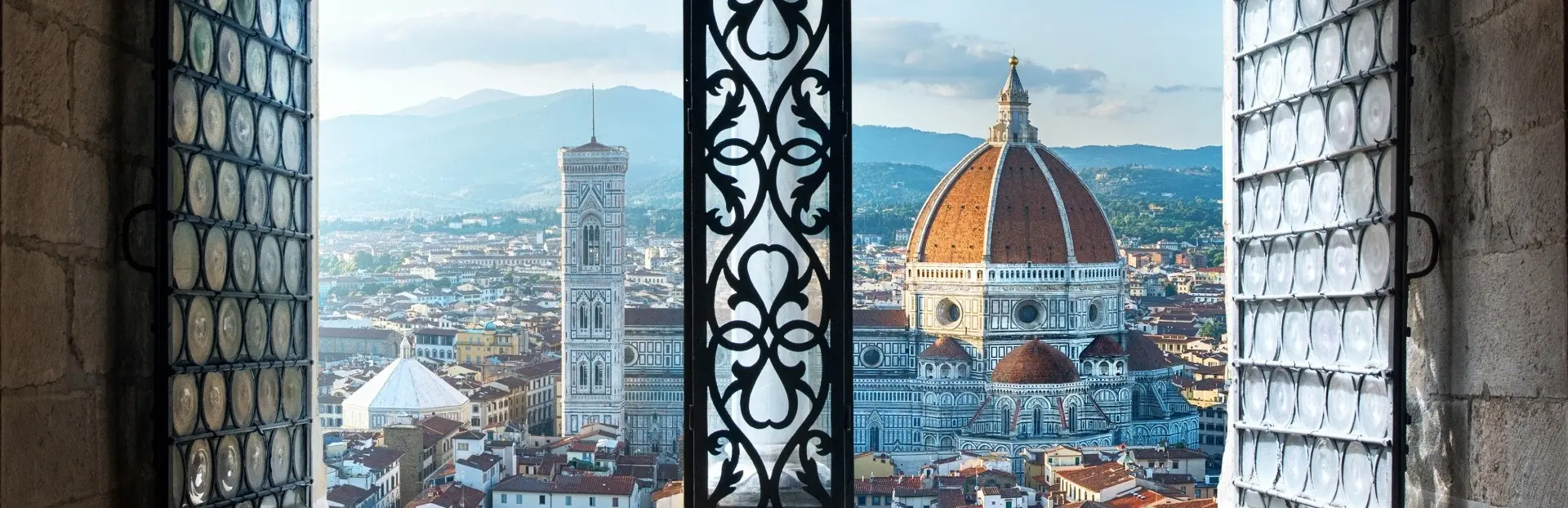
Walk the city that made Dante, cast him out and later claimed him.
A 90-minute Dante walking tour through medieval Florence. Follow the places associated with Beatrice, factional violence and civic government to understand Dante as a Florentine citizen as well as a poet.
See what you will understandSee the poet within the streets, guilds and institutions that shaped his public life.
Separate the traces of medieval Florence from later stories about Beatrice and Dante's house.
Move from Piazza San Giovanni to Santa Croce through love, violence, government and exile.
Editorial perspective
Dante's Florence was a dense political city, not a picturesque backdrop to a famous life. Guild membership could open a path to office; family alliances and factional struggles could close it again.
The walk uses surviving streets and civic buildings to follow that tension. It ends with Florence's later monument to a man the city had condemned, asking what public remembrance can and cannot undo.
A concise preview of what you will hear along the walk.
Start in Piazza San Giovanni at the building Dante remembered from exile, with the medieval city close behind its marble walls.
Find a rounded medieval tower set over Roman remains, one of the older layers of the Florence Dante knew.
Pause at a church traditionally associated with Beatrice Portinari, and consider how a literary figure acquired places of memory.
Compare a reconstructed house of memory with the nearby tower associated with Florence's early civic government.
And more along the route.
Love, blood and exile become ways to read the city Dante lived in, rather than labels attached to a biography.
The route gives each place a role in a connected account of medieval Florence.
The Baptistery anchors Dante in the city whose streets, faith and civic life formed him.
Santa Margherita and Casa di Dante invite you to ask what survives and what later generations reconstructed.
Guilds, towers and factional sites show the pressures behind Dante's political career.
The Bargello and Santa Croce frame the distance between a sentence of exile and a later monument.
An article can tell you when Dante lived and what he wrote. This walk lets the city's buildings set those facts in order, from the institutions he entered to the places Florence later remade in his memory.
You want the poet's Florence to make sense without needing to read a biography before you arrive.
You are interested in how guilds, faction and civic justice worked within the old city.
You prefer to follow a coherent cultural route at your own pace, without a group schedule.
You want to understand what Florence remembers, reconstructs and leaves unresolved.
The self-guided walking tour takes about 90 minutes, covers about two kilometres and includes 29 VoiceMap locations.
The published directions start in Piazza San Giovanni, facing the Baptistery of San Giovanni. The walk ends at Dante's statue in Piazza Santa Croce.
The focus is the Florentine city around Dante: its traditions of love, family conflict, guilds, politics, judgment and later commemoration.
The building visitors see today is largely a twentieth-century reconstruction in the area associated with the Alighieri family, rather than an untouched medieval home.
The route follows outdoor streets and squares. Any museum or church visit is optional; check opening times and admission separately.
Open the tour on VoiceMap for current access and listening information. GeoBeat presents the editorial overview here.
Begin at the Baptistery, follow the city's political and personal stories, and reach its later tribute at Santa Croce.